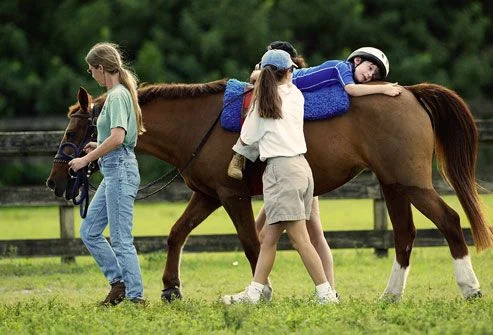
What Is Hippotherapy?
Hippotherapy: is a therapeutic approach in which a trained
therapist uses the movement of a horse as a treatment tool to address specific
physical, sensory, and functional goals.
The horse's rhythmic and multidirectional movement provides
continuous movement and sensory input that can be used to challenge and
facilitate postural control, balance, coordination, pelvic movement, and
functional mobility.
Hippotherapy is different from therapeutic horseback riding.
The focus is not on learning to ride; instead, the therapist uses the horse's
movement to achieve individualized therapeutic goals.
How Can Hippotherapy Help?
During a session, the child's body continuously responds to
the horse's movement. This can provide opportunities to practice:
. Postural Control & Balance:
The changing movement of the horse encourages the child to
make continuous postural adjustments, which may support trunk control, balance,
and balance reactions.
. Core & Motor Control:
Maintaining an upright position requires active control of
the trunk and pelvis. Therapeutic activities can further challenge coordination
and postural stability.
. Pelvic Movement & Mobility
The horse's walking movement produces rhythmic movement of
the rider's pelvis in multiple directions. This may help facilitate pelvic
mobility, weight shifting, and movement control.
. Gait & Functional Movement
The movement of the horse provides a repetitive movement
experience that shares some characteristics with human walking. Hippotherapy
may therefore be incorporated into rehabilitation programs targeting gait and
functional mobility.
. Sensory-Motor Integration
The child receives combined vestibular, proprioceptive,
tactile, and visual input. This can provide opportunities to develop body
awareness, coordination, and motor planning.
How Is the Session Adapted to the Child?
Hippotherapy is not the same for every child.
The therapist can modify the activity according to the
child's goals by changing factors such as:
- . Horse
speed
- . Direction
of movement
- . Position
on the horse
- . Duration
and intensity of activities
- The
child's position and therapeutic tasks
For example, changes in direction can encourage weight
shifting and balance reactions, while speed changes can challenge postural
control and motor responses.
Who May Benefit?
Hippotherapy may be considered for children and adults with
selected neurological, developmental, and musculoskeletal conditions, including
cerebral palsy and other conditions affecting posture, balance, coordination,
or functional movement.
Research is particularly supportive of potential
improvements in postural control and gross motor function in children with
cerebral palsy, although results vary between individuals and studies.
A professional assessment is important to determine whether
hippotherapy is appropriate for the individual's condition and goals.
Safety
Hippotherapy should be provided by appropriately trained
professionals using a suitable, well-trained horse and appropriate safety
equipment.
Before starting, the child's medical history, physical
abilities, orthopedic status, balance, communication, and sensory needs should
be considered.
Some medical, orthopedic, neurological, or behavioral
conditions may require hippotherapy to be modified or avoided. Appropriate
screening and clinical assessment are therefore essential.
What Should Parents Expect?
Hippotherapy is not a quick fix or a replacement for
conventional therapy.
It is an individualized therapeutic tool that can be
incorporated into a broader rehabilitation program to provide meaningful
opportunities for movement practice and functional participation.
The therapist sets measurable goals and monitors the child's
response and progress over time.
Hippotherapy at The One Physical Therapy Center
At The One Physical Therapy Center, we consider hippotherapy
when it is appropriate for the child's condition, abilities, and therapeutic
goals.
Our approach focuses on using the horse's movement
purposefully to support postural control, balance, coordination, mobility, and
functional skills within an individualized rehabilitation program.
Every child is different. The goal is to use the movement of
the horse in a safe, purposeful, and evidence-informed way to help the child
move and participate more effectively.
References:
Antunes, F. N., Pinho, A. S., Kleiner, A. F. R., Salazar, A.
P., Eltz, G. D., de Souza, A. F., & Pagnussat, A. S. (2016). Different
horse's paces during hippotherapy on spatiotemporal parameters in children with
bilateral spastic cerebral palsy: A feasibility study. Developmental
Neurorehabilitation, 19(4), 250–256. https://doi.org/10.3109/17518423.2014.984768
Benda, W., McGibbon, N. H., & Grant, K. L. (2003).
Improvements in muscle symmetry in children with cerebral palsy after
equine-assisted therapy (hippotherapy). Journal of Alternative and
Complementary Medicine, 9(6), 817–825. https://doi.org/10.1089/107555303771952163
Garner, B. A., & Rigby, B. R. (2015). Human pelvis
motions when walking and when riding a therapeutic horse. Human Movement
Science, 39, 121–137. https://doi.org/10.1016/j.humov.2014.06.011
Kwon, J. Y., Chang, H. J., Yi, S. H., Lee, J. Y., Shin, H.
Y., & Kim, Y. H. (2015). Effect of hippotherapy on gross motor function in
children with cerebral palsy: A randomized controlled trial. Journal of
Alternative and Complementary Medicine, 21(1), 15–21. https://doi.org/10.1089/acm.2014.0023
Peia, F., et al. (2023). Effects of hippotherapy on postural
control in children with cerebral palsy: A systematic review. Developmental
Neurorehabilitation.
Stergiou, A., Tzoufi, M., Kellis, E., & Fotiadou, E.
(2006). Effects of therapeutic horseback riding on the postural control of
children with cerebral palsy. Therapeutic Recreation Journal, 40(1),
13–23.