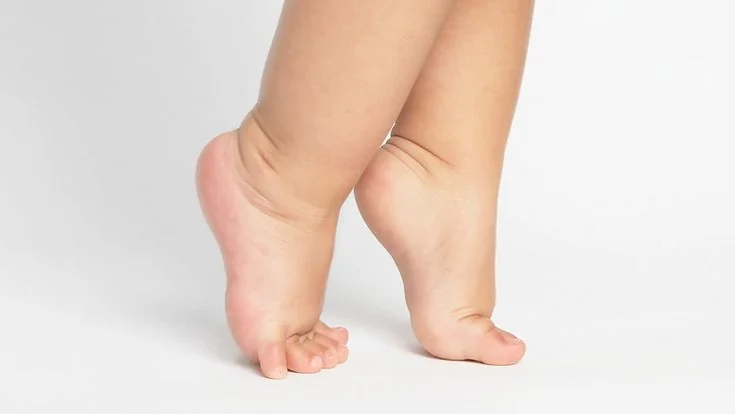
What Is Toe Walking?
Toe
walking is a gait pattern in which a child walks primarily on the forefoot,
with limited or absent heel contact. It may occur occasionally or as a
consistent walking pattern.
When Is Toe Walking Normal?
Toe
walking is common in toddlers during early walking development. Most children
naturally outgrow this pattern by 2–3 years of age as balance and coordination
mature and a normal heel-to-toe gait develops.
When Is Toe Walking Not Normal?
Toe
walking requires professional evaluation when it:
- . Persists
beyond 2–3 years
- . Becomes
the child’s main walking pattern
- . Does not
improve or worsens over time
Red Flags
Assessment is recommended if toe walking is associated with:
- . One-sided
toe walking
- . Inability
to place heels on the ground
- . Frequent
falls or poor balance
- . Pain,
stiffness, or difficulty wearing shoes
- . Progressive
calf tightness
- . Developmental
delays (speech, social, or motor)
Causes of Toe Walking
Toe walking may be due to:
- . Muscle
tightness (calf muscles or Achilles tendon)
- . Habitual
walking patterns
- . Sensory
processing differences
It may also be associated with medical conditions such as:
- . Cerebral
palsy
- . Congenital
Achilles tendon contracture
- . Neuromuscular
disorders (e.g., Duchenne muscular dystrophy)
When no specific cause is identified, it is classified as Idiopathic Toe Walking (ITW), which may be associated with neurodevelopmental conditions, including autism spectrum disorder.
Possible Complications
Persistent toe walking may lead to:
- . Calf and
Achilles tendon shortening
- . Reduced
ankle dorsiflexion
- . Poor
balance and altered gait mechanics
- . Increased
stress on the feet, knees, and hips
- . Long-term
postural and movement inefficiencies
Assessment of Toe Walking
Comprehensive assessment includes:
- . Gait
observation
- . Ankle
range of motion testing
- . Silverside
Test to differentiate gastrocnemius versus soleus tightness
- . Muscle
strength and tone assessment
- . Neurological
screening
- . Functional
movement tests
- . Additional
investigations when clinically indicated
Physical Therapy Management
Treatment is individualized and evidence-based and may include:
- . Calf
stretching (passive and dynamic)
- . Strengthening
of lower limb and proximal muscles
- . Balance
and gait training
- . Manual
therapy techniques
- . Sensory-based
interventions
- . Orthoses
or serial casting when needed
Importance of Early Intervention
Early identification and targeted intervention:
- . Prevent
permanent muscle shortening
- . Improve
gait quality and balance
- . Reduce
future orthopedic complications
- . Support
optimal motor development
Accurate diagnosis and individualized treatment significantly improve long-term outcomes.
- . Calf
stretching (passive and dynamic)
Engström, P., Tordoff, K., & Haglund-Akerlund, Y. (2012). Toe-walking in children: Prevalence, persistence and associations with motor and sensory development. Acta Pediatric, 101(2), 179–183.
https://doi.org/10.1111/j.1651-2227.2011.02489.xFox, A., Deakin, S., Pettigrew, G., & Paton, R. (2006). Serial casting in the treatment of idiopathic toe-walkers. Acta Orthopaedical Belgica, 72(6), 722–730.
Hirsch, G., & Wagner, B. (2004). The natural history of idiopathic toe-walking. Acta Pediatrician, 93(2), 196–199.
Williams, C. M., Tinley, P., & Curtin, M. (2010). The toe walking tool. Gait & Posture, 32(4), 508–511.
https://doi.org/10.1016/j.gaitpost.2010.07.010- . Gait
observation
- . Calf and
Achilles tendon shortening
- . Cerebral
palsy
- . Habitual
walking patterns
- . Muscle
tightness (calf muscles or Achilles tendon)
- . One-sided
toe walking