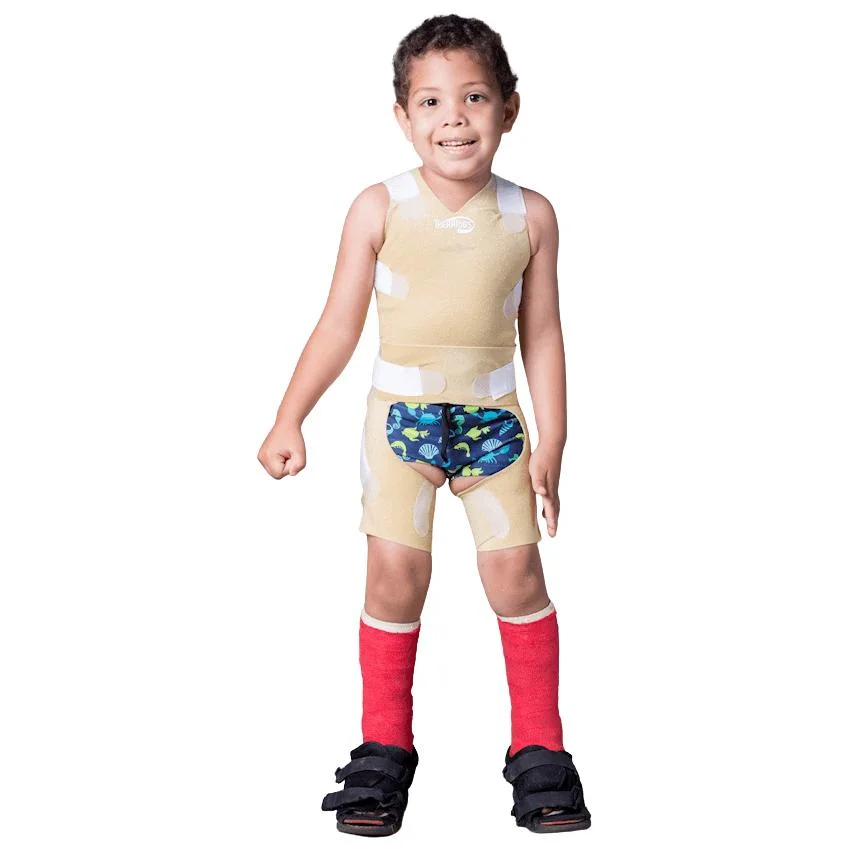
Thera Togs is a wearable orthotic and strapping system
used as an adjunct to pediatric physical therapy for children with difficulties
in postural control, alignment, balance, movement, and functional mobility.
It consists of a soft
garment with adjustable elastic straps that can provide external support,
postural guidance, and tactile/proprioceptive input during movement. TheraTogs
does not replace physical therapy; it is used alongside active, goal-directed rehabilitation.
What Is TheraTogs?
- TheraTogs is a flexible wearable
system designed to influence the
- alignment and movement of the trunk,
pelvis, hips, and lower extremities.
- Unlike rigid orthoses, its straps
can be individually positioned and adjusted according to the child's
movement pattern, alignment, range of motion, and therapeutic goals.
How Does It Work?
TheraTogs may
support rehabilitation through:
- . External support: providing stability to
selected body segments.
- . Postural and alignment guidance:
applying directional forces to encourage more optimal
alignment.
- . Tactile and proprioceptive input:
increasing awareness of body position and movement.
The effect varies
between children and depends on their diagnosis, impairments, and treatment
goals.
Who May Benefit?
TheraTogs may be
considered for children with flexible or manually correctable movement and
postural impairments, including:
- . Cerebral palsy
- . Hypotonia
- . Hemiplegia following neurological injury
- . Postural control difficulties
- . Pelvic asymmetry
- . Lower-limb alignment or gait impairments
- . Intoning or out-toeing
- . Knee hyperextension
- . Scissoring gait
- . Ligamentous laxity
- Balance and body-awareness difficulties
However, it is not
appropriate for every child with these conditions. Individual clinical
assessment is essential.
What Can It Support?
Depending on the
child's needs, TheraTogs may be incorporated to support:
- . Trunk and pelvic stability
- . Postural control and balance
- . Movement symmetry
- . Lower-limb alignment
- . Functional transitions
- . Gait and mobility training
The goal is not simply
to "correct" posture, but to provide appropriate external input while
the child actively practices functional movement.
Individualized
Fitting:
There is no single
strapping pattern suitable for every child.
The therapist should
assess posture, alignment, range of motion, muscle control, balance, gait, and
functional movement before selecting the appropriate garment and strap
configuration.
The system should also
be reassessed as the child grows or as movement patterns change.
TheraTogs as Part
of Physical Therapy
TheraTogs works
best as an adjunct to active therapy, which may include:
- . Strengthening
- . Postural and balance training
- . Gait training
- . Functional transitions
- . Developmental motor activities
- . Task-specific practice
- . Proprioceptive activities
Wearing Time:
Wearing time should be
individualized according to the child's age, diagnosis, goals, comfort, skin
tolerance, fatigue, and response to treatment.
Parents should follow
the therapist's recommended schedule and should not independently increase
wearing time or modify strap tension.
Safety and
Precautions
TheraTogs requires
clinical consideration in children with certain medical conditions, including
some cardiac conditions, poorly healing fractures, VP shunts, conditions
affected by compression, or rigid/non-correctable deformities.
It should not be
applied over painful areas, unstable injuries, significant skin problems, or
recent surgical sites unless medically cleared.
Parents should monitor
for persistent redness, skin breakdown, swelling, pain, breathing difficulties,
or significant discomfort and contact the treating therapist if these occur.
What Does the
Research Say?
Current research
suggests that wearable orthotic systems such as TheraTogs may provide benefits
for selected children with neuromotor and postural impairments, although the
evidence remains developing.
A 2024 randomized
controlled trial in children with spastic diplegic cerebral palsy reported
improvements in functional independence and quality-of-life-related outcomes.
However, results from a single study cannot be generalized to every child.
Therefore, TheraTogs
should be used within an individualized, goal-directed, evidence-informed
rehabilitation program, with objective assessment and regular reassessment.
TheraTogs at The
One Physical Therapy Center:
At The One Physical
Therapy Center, TheraTogs is considered when clinically appropriate as part of
an individualized pediatric rehabilitation program.
Our therapists assess
each child's posture, alignment, muscle control, movement, balance, gait,
functional abilities, and rehabilitation goals before selecting and adjusting
the system.
Our goal is to use
TheraTogs strategically alongside active therapy to support better alignment,
movement quality, postural control, and functional participation.
Every child is
different, so the appropriate use and effectiveness of TheraTogs should always
be evaluated individually.
References:
Emara, H. A., Sobh,
E., Almohammadi, R. H., Alamri, E. A., Aljohani, M. M. A., & Alhammad, A.
A. (2024). Quality of life and functional independence of TheraTogs in children
with spastic diplegic cerebral palsy: A randomized controlled clinical trial. Journal
of Multidisciplinary Healthcare, 17, 4645–4652. https://doi.org/10.2147/JMDH.S485973
TheraTogs. (n.d.). Dragonfly
TLSO system. https://theratogs.com/product/dragonfly-tlso-system/
TheraTogs. (n.d.). Full
body system. https://theratogs.com/product/full-body-system/
TheraTogs. (n.d.). Lower
extremity system. https://theratogs.com/product/lower-extremity-system/