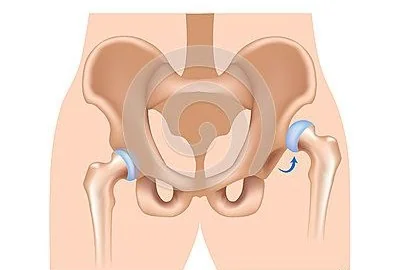
Hip dislocation in pediatrics is defined as the loss of normal anatomical alignment between the femoral head and the acetabulum. In children, hip dislocation most commonly occurs as part of Developmental Dysplasia of the Hip (DDH), while traumatic hip dislocation, though less common, is an orthopedic emergency.
Developmental Dysplasia of the Hip (DDH)
DDH is the leading cause of hip dislocation in pediatric patients. It is a spectrum of developmental abnormalities, ranging from mild acetabular dysplasia and hip instability to subluxation and complete dislocation of the femoral head. Importantly, DDH is not always congenital and may develop postnatally due to abnormal hip development (Noordin, Umer, Hafeez, & Nawaz, 2010).
Common forms of DDH:
• Hip instability: Femoral head displaces under stress but spontaneously returns to the acetabulum.
• Subluxation: Partial loss of contact between femoral head and acetabulum.
• Complete dislocation: Total loss of contact between the femoral head and acetabulum.
• Teratologic hip dislocation: Rare, rigid dislocation present at birth, often associated with neuromuscular or syndromic conditions such as arthrogryposis (Bernstein, 2002).
Untreated DDH may lead to abnormal gait, chronic hip pain, and early-onset osteoarthritis.
Traumatic Hip Dislocation
Traumatic hip dislocation in children usually results from external forces such as falls, motor vehicle accidents, or sports injuries. Pediatric hips are more vulnerable to dislocation than adult hips due to ligamentous laxity and incomplete ossification (Suominen et al., 2022).
Types of Traumatic Hip Dislocation:
• Posterior: Most common (90–95%), hip typically flexed, adducted, and internally rotated.
• Anterior: Less common, may be subdivided into obturator or iliac types.
• Central: Rare, associated with acetabular fractures.
Risk Factors
Key risk factors for DDH include:
• Breech position during pregnancy
• Family history of hip dysplasia
• Female sex (ligamentous laxity due to maternal hormones)
• Premature birth or low birth weight
• Twin or multiple pregnancy
• Oligohydramnios (low amniotic fluid)
• Improper swaddling after birth
Note for parents: Having one or more risk factors does not guarantee your child will develop DDH, but early screening is essential for timely detection and treatment (Bordbar et al., 2018).
Early Signs and Detection
Parents may notice:
• A “click” or “clunk” when moving the baby’s legs
• Unequal thigh or gluteal folds
• Limited leg movement on one side
• Leg length discrepancy or limp as the child begins walking
Early detection allows non-surgical interventions such as the Pavlik harness, which support normal hip development and reduce the need for complex surgeries later (Curry & Gibson, 1992).
Diagnosis:
Hip dislocation is primarily diagnosed using clinical maneuvers and imaging:
• Ortolani Test: Detects dislocated hip; a positive test is felt as a “click” when the femoral head returns to the acetabulum.
• Barlow Test: Identifies an unstable hip by demonstrating the ability to dislocate the femoral head.
• Ultrasonography: Gold standard for infants <6 months, visualizing cartilaginous structures.
• Radiography: Used in older infants once ossification begins (Churgay & Caruthers, 1992; StatPearls, 2025).
Treatment and Management
A multidisciplinary approach is essential for pediatric hip disorders, including children with DDH, cerebral palsy, Down syndrome, or arthrogryposis:
• Conservative management: First line, includes bracing, splinting, and positioning.
• Medical interventions: Muscle relaxants or botulinum toxin may help in neuromuscular cases.
• Physiotherapy: Maintains joint range of motion, reduces abnormal forces, strengthens muscles, and improves function. Family education is essential for home care.
• Surgery: Considered only if conservative measures fail or deformity progresses.
• Long-term follow-up: Critical to detect recurrence or new instability as the child grows (Battisti et al., 2023; Koehler et al., 2024).
References:
• Battisti, N., Cozzaglio, M., Faccioli, S., Perazza, S., Groppi, A., Menta, L., ... & Cersosimo, A. (2023). Prevention of hip dislocation in severe cerebral palsy (GMFCS III–IV–V): An interdisciplinary and multi-professional care pathway for clinical best practice implementation. European Journal of Physical and Rehabilitation Medicine, 59(6), 714–723. https://doi.org/10.23736/S1973-9087.23.07978-9
• Bernstein, R. M. (2002). Arthrogryposis and amyoplasia. Journal of the American Academy of Orthopaedic Surgeons, 10(6), 417–424. https://doi.org/10.5435/00124635-200211000-00006
• Bordbar, M., et al. (2018). Risk factors for developmental hip dysplasia. Brieflands Journal of Comprehensive Pediatrics, e14049.
• Churgay, C. A., & Caruthers, B. S. (1992). Diagnosis and treatment of congenital dislocation of the hip. American Family Physician, 45(3), 1217–1228. PMID: 1543106
• Curry, L. C., & Gibson, L. Y. (1992). Congenital hip dislocation: The importance of early detection and comprehensive treatment. The Nurse Practitioner, 17(5), 49–55.
• Koehler, R., Pathy, R., Gregory, D., Mooney, J. F., & Gannotti, M. E. (2024). Hip dysplasia and dislocation in Down syndrome: Is there evidence to support consideration of routine hip surveillance? Journal of Pediatric Orthopaedics Society of North America, 8, 100074. https://doi.org/10.1016/j.jposna.2024.100074
• Noordin, S., Umer, M., Hafeez, K., & Nawaz, H. (2010). Developmental dysplasia of the hip. Orthopedic Reviews, 2(2), e19.
• StatPearls. (2025). Developmental dysplasia of the hip. National Center for Biotechnology Information (NCBI).
• Suominen, E., et al. (2022). Traumatic hip dislocation in pediatric patients. Children (MDPI).